

- Published: February 5,2026
Xcode 26.3 Introduces Agentic Coding with Claude & OpenAI Codex
Introduction
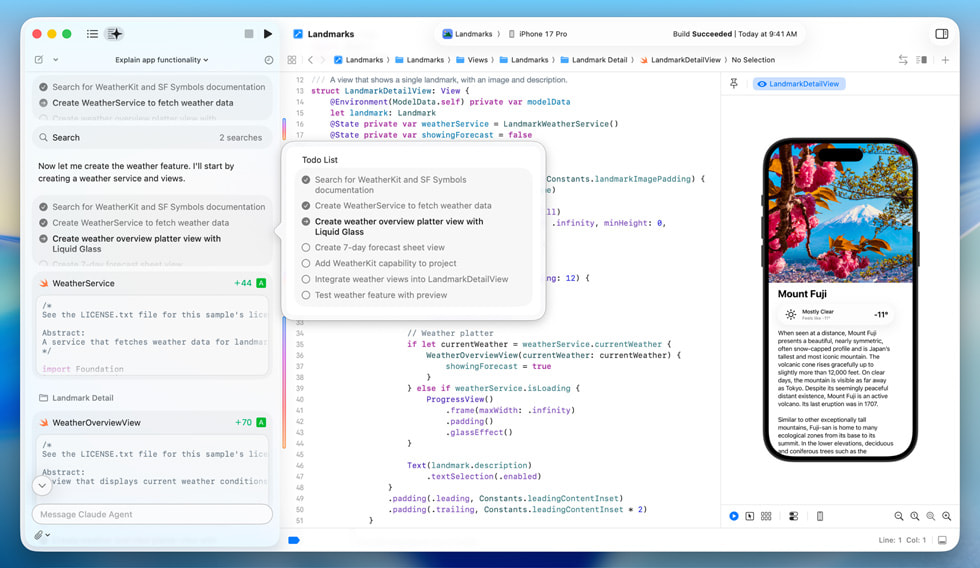
Apple has taken a major step forward in AI-assisted software development with the release of Xcode 26.3, introducing official support for agentic coding. This update allows developers to work alongside autonomous coding agents, including Anthropic’s Claude Agent and OpenAI’s Codex directly inside Xcode.
Rather than acting as simple code suggestion tools, these agents can now collaborate across the entire development lifecycle, helping teams build applications faster, more efficiently, and with greater confidence.
What Is Agentic Coding?
Agentic coding represents a shift from traditional AI code assistants to goal-oriented coding agents.
Instead of responding only to individual prompts, agentic coding enables AI agents to:
Break down complex development tasks
Make decisions based on project architecture
Navigate file structures and project settings
Search documentation contextually
Build, test, and iteratively fix code
Verify results visually using Xcode Previews
In short, these agents operate with greater autonomy, acting more like a junior developer embedded in your IDE rather than a passive autocomplete tool.
What’s New in Xcode 26.3

Xcode 26.3 builds on the intelligence features introduced in Xcode 26 and expands them significantly.
With this update, supported agents such as Claude Agent and OpenAI Codex gain deeper access to Xcode’s native capabilities, allowing them to:
Explore and understand project structures
Update build and project settings
Run builds and diagnose errors
Capture and review UI previews
Iterate through fixes with contextual awareness
This tighter integration enables agents to collaborate meaningfully with developers from early prototyping to debugging and refinement.
Why This Matters for Development Teams
For engineering teams, especially those working at scale, agentic coding can deliver real operational impact:
Faster Development Cycles
Agents can handle repetitive or time-consuming tasks autonomously, allowing developers to focus on higher-value problem solving and architecture decisions.
Improved Consistency
By understanding project context and structure, agents help reduce human error and enforce more consistent implementation patterns.
Better Onboarding
New developers can rely on agents to explore unfamiliar codebases, locate relevant files, and understand dependencies more quickly.
Increased Productivity Without More Headcount
Agentic coding enables teams to do more with existing resources, a key advantage in competitive and cost-conscious environments.
Flexible AI Model Support via Open Standards
In addition to built-in support for Claude Agent and Codex, Xcode 26.3 also exposes its capabilities through the Model Context Protocol (MCP), an open standard.
This means organizations are not locked into a single AI provider. Teams can integrate any compatible agent or tool that supports MCP, offering flexibility for:
Security and compliance requirements
Model performance preferences
Cost optimisation strategies
For enterprises, this openness is a critical step toward responsible and customizable AI adoption.
A Strategic Move for the Future of Software Development
Apple’s introduction of agentic coding signals a broader shift in how software will be built going forward. Development tools are no longer just environments for writing code, they are becoming collaborative platforms where humans and AI agents work side by side.
As Susan Prescott, Apple’s Vice President of Worldwide Developer Relations, noted, the goal is to put industry-leading technologies directly into developers’ hands so they can focus on innovation rather than manual overhead.
Final Thoughts
Xcode 26.3 is more than just an incremental update, it marks a meaningful evolution in AI-assisted development. By embedding agentic coding directly into the developer workflow, Apple is redefining what productivity, collaboration, and speed look like for modern app teams.
For organizations building on Apple platforms, now is the time to explore how agentic coding can fit into development processes, not as a replacement for developers, but as a powerful force multiplier.